
Proximal Humerus Fracture Treatment in Adelaide
Broken shoulder care with Dr Arthur Turow, shoulder and upper limb surgeonA proximal humerus fracture is a break at the top of the upper arm bone, just below the shoulder. Most people call it a broken shoulder. It is one of the most common fractures after a fall, particularly in people over 60 [1]. Many heal in a sling without surgery. Your first X-rays answer two questions: has the ball stayed in its socket, and are the broken pieces close enough together to heal well?
Dr Arthur Turow treats shoulder fractures at Wakefield Orthopaedic Clinic in Adelaide and at regional clinics across South Australia. If you have already been seen in an emergency department, bring your X-rays or imaging access details and your discharge letter. At your appointment you can talk through how long you need the sling, when to start moving your shoulder and whether surgery is needed.

Shoulder X-ray
A proximal humerus fracture: the break is at the top of the upper arm bone, just below the ball of the shoulder.
Proximal humerus fractures at a glance
What it is:
A break at the top of the humerus, near the shoulder, often caused by a fall
First treatment:
Many fractures heal with a sling, pain relief and follow-up X-Rays
Early movement:
With a stable fracture, gentle shoulder exercises can often begin in the first few weeks
When is surgery considered:
Your shoulder is broken and dislocated, or a fragment has moved too far and will affect how your shoulder works
Recovery:
The fracture starts healing around six weeks. Reaching overhead and regaining strength usually take longer
What is a proximal humerus fracture?
The humerus runs from your shoulder to your elbow, and its top end forms the ball of the shoulder joint. A fall can break the bone just below the ball (the surgical neck), through the ball itself, or where the rotator cuff tendons attach. In older adults, a fall from standing height is often enough. In younger people it usually takes more energy, such as a sporting injury or a car accident. Surgeons describe these fractures by how many main pieces there are and how far they have moved [2]. That description helps decide treatment.
A broken collarbone is a different injury. The collarbone runs across the top of the chest and has its own treatment and recovery. Read about clavicle fracture treatment.
Symptoms and diagnosis of a broken shoulder
The shoulder and upper arm hurt straight away, and lifting the arm is difficult. Bruising appears over the next few days and often tracks down the arm to the elbow, or onto the chest. This looks alarming but is normal. If your hand becomes cold or pale, or you develop new numbness, go to an emergency department straight away.
Shoulder X-rays usually show where the bone has broken and whether the joint is dislocated. A CT scan helps when several pieces overlap on the X-ray, or when more detail is needed to decide on or plan surgery.

3D CT scan
A CT reconstruction shows each fragment (arrow) and helps decide between a sling and surgery.
What does my X-ray report mean?
| Term on your X-ray report | What it means for your shoulder |
|---|---|
| Surgical neck fracture | “Surgical neck” means the break is just below the ball of the shoulder. Many fractures here heal in a sling. |
| Greater tuberosity fracture | A piece of bone has broken where the rotator cuff tendons attach. These tendons help you lift and turn your arm. A follow-up X-ray is usually needed to ensure the fragment has not moved. |
| Displaced fracture | The broken pieces have shifted or tilted. How far they have moved, and in which direction, helps to decide whether to treat the fracture in a sling or with surgery. |
| Fracture-dislocation | The upper arm is broken and the ball of the shoulder has also come out of its socket. This usually needs urgent care and potentially surgery. |
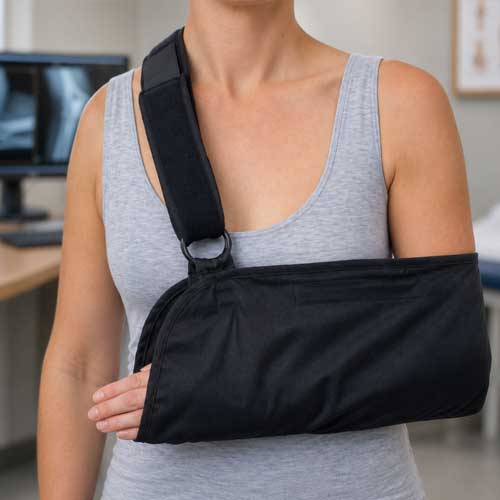
Sling for a broken shoulder
Most stable fractures heal in a sling, with gentle exercises started by your physio.
Proximal humerus fracture treatment without surgery
For most displaced fractures of the surgical neck, a large UK trial found that people treated in a sling did as well over two years as those who had surgery [3]. A Cochrane review reached the same conclusion for most fracture types [4].
How long will I need the sling?
A sling or collar and cuff supports the weight of the arm while the fracture is painful. For most stable fractures, you wear it for about six weeks. Your physio will show you how to take the arm out safely for washing, dressing and exercises.
When can I start moving my shoulder?
You can move your fingers, wrist and elbow from the start. With a stable fracture, gentle pendulum exercises usually begin in the first one to two weeks: lean forward and let the arm hang and swing gently. Starting early, under physio guidance, gives a faster return of function than keeping the shoulder still for several weeks [5, 6]. Lifting your arm above your head or taking weight through it waits until at least six weeks.
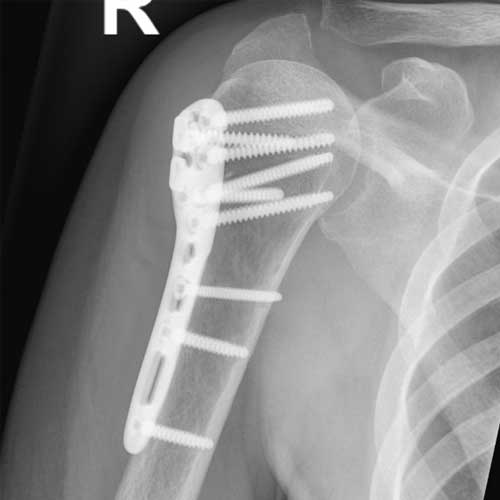
Plate and screw fixation
An X-ray after surgery: a locking plate holds the fragments in position while the bone heals.
Proximal humerus fracture surgery in Adelaide
When is surgery needed?
The decision to fix a fracture can be complex. It takes into account how you use your arm, your goals, the fracture itself, the quality of the bone and any injury to the surrounding soft tissues. A fracture can look quite displaced on an X-ray and still heal with useful function. Dr Turow will go through these factors with you.
Proximal humerus fracture fixation
Fixation means putting the pieces back into position and holding them with a plate and screws while the bone heals. It does not make the bone heal faster. Its job is to make sure the bone heals in a position that lets the shoulder work properly.
Reverse shoulder replacement for complex fractures
Sometimes the ball of the shoulder is broken into several pieces, or the bone is too soft for screws to hold. In this situation a reverse shoulder replacement is often more reliable than trying to fix the bone. For people over 70, it gives better function than a standard (half) shoulder replacement [7]. In people over 80, function at one year can be similar to sling treatment, with less pain after a replacement [8]. Dr Turow will talk through which option suits your shoulder and your daily activities. Read more about reverse shoulder replacement.
Proximal humerus fracture recovery time
The recovery time for a proximal humerus fracture can vary depending on your specific injury. In general, you will wear a sling for six weeks and are encouraged to move your elbow, wrist and hand. The bone commonly takes 6 to 12 weeks to heal. The following is a general guide.
Initial healing (1–2 weeks)
- You need to wear a sling
- The focus is on managing swelling and pain
- Move your elbow, wrist and hand from the start; shoulder exercises are guided by your physio
Early rehab (2–6 weeks)
- Pain settles gradually
- You will usually have a follow-up X-ray to check the position
- Avoid heavy lifting, pushing up from a chair with that arm and reaching overhead
Early strengthening (6–12 weeks)
- You wean out of the sling
- Active shoulder movement starts
- Keep lifting to 2–3 kg
Return to normal activities (from 3 months)
- Lifting limits are usually lifted by this stage
- The focus moves to strength and endurance
- Overhead reach often keeps improving for 6 to 12 months
Broken shoulder treatment with Dr Arthur Turow in Adelaide
Whether a proximal humerus fracture heals well in a sling or needs surgery depends on more than how far the pieces have moved on the X-ray. Dr Turow weighs the fracture pattern, the strength of the bone, whether the rotator cuff attachments are involved and what you need your shoulder to do. He also performs reverse shoulder replacement, so if a plate and screws are unlikely to hold, that option is covered in the same appointment.
He is a staff specialist orthopaedic surgeon at the Royal Adelaide Hospital and The Queen Elizabeth Hospital.
Dr Turow consults at Wakefield Orthopaedic Clinic, 120 Angas Street, Adelaide, and in Gawler, Mount Barker, Moonta and Port Pirie. When you book, say that it is a recent fracture, and bring your discharge letter and imaging details. Book online or call (08) 8236 4179.
Frequently Asked Questions
How painful is a broken shoulder?
The first one to two weeks are the worst. Pain is often sharpest at night and when you move from lying to sitting. Regular pain relief, a well-fitted sling and an ice pack for 15 to 20 minutes at a time help. Most people find the pain much easier by three to four weeks. If your pain is getting worse rather than better, contact the rooms.
How do I sleep with a broken shoulder?
Most people sleep better half-upright for the first few weeks, in a recliner or propped up on pillows. Keep the sling on at night early on. A pillow under the elbow takes weight off the shoulder. Avoid lying on the broken side until your physio or Dr Turow says it is fine.
How long does a broken shoulder take to heal?
The bone usually heals in 6 to 12 weeks. Getting your movement and strength back takes longer, often three to six months, and reaching overhead can keep improving for up to a year.
Is there a way to make a broken shoulder heal faster?
Unfortunately, no. The bone heals at its own pace. You can avoid slowing it down. Do not smoke. Eat well, with enough protein, calcium and vitamin D. Do your exercises as your physio shows you. Moving the shoulder early, when it is safe, leads to a quicker return of function [5].
How much time off work will I need?
It depends on your job and which arm is broken. Desk work is often possible after two weeks, sometimes one-handed. Work involving lifting, pushing, pulling or ladders usually needs around three months.
When can I drive with a broken shoulder?
Not while you are in a sling. You need enough movement and strength to steer, change gear and react in an emergency. For most people that is somewhere between six and ten weeks. Read the driving after an upper limb injury guide.
Further reading
Patient information
- Cambridge University Hospitals: Proximal humeral fractures. Bruising, sleeping, sling use and everyday tasks.
- Healthdirect Australia: Osteoporosis. Bone density testing and fracture prevention after a low-impact fall.
- NSW Agency for Clinical Innovation: Proximal humerus fractures. An Australian emergency care summary.
References
- Court-Brown CM, Garg A, McQueen MM. The epidemiology of proximal humeral fractures. Acta Orthop Scand. 2001;72(4):365–371. doi:10.1080/000164701753542023
- Neer CS 2nd. Displaced proximal humeral fractures. Part I. Classification and evaluation. J Bone Joint Surg Am. 1970;52(6):1077–1089.
- Rangan A, Handoll H, Brealey S, et al. Surgical vs nonsurgical treatment of adults with displaced fractures of the proximal humerus: the PROFHER randomized clinical trial. JAMA. 2015;313(10):1037–1047. doi:10.1001/jama.2015.1629
- Handoll HHG, Elliott J, Thillemann TM, Aluko P, Brorson S. Interventions for treating proximal humeral fractures in adults. Cochrane Database Syst Rev. 2022;6:CD000434. doi:10.1002/14651858.CD000434.pub5
- Lefevre-Colau MM, Babinet A, Fayad F, et al. Immediate mobilization compared with conventional immobilization for the impacted nonoperatively treated proximal humeral fracture: a randomized controlled trial. J Bone Joint Surg Am. 2007;89(12):2582–2590.
- Hodgson SA, Mawson SJ, Stanley D. Rehabilitation after two-part fractures of the neck of the humerus. J Bone Joint Surg Br. 2003;85(3):419–422.
- Sebastiá-Forcada E, Cebrián-Gómez R, Lizaur-Utrilla A, Gil-Guillén V. Reverse shoulder arthroplasty versus hemiarthroplasty for acute proximal humeral fractures: a blinded, randomized, controlled, prospective study. J Shoulder Elbow Surg. 2014;23(10):1419–1426.
- Lopiz Y, Alcobía-Díaz B, Galán-Olleros M, et al. Reverse shoulder arthroplasty versus nonoperative treatment for 3- or 4-part proximal humeral fractures in elderly patients: a prospective randomized controlled trial. J Shoulder Elbow Surg. 2019;28(12):2259–2271. doi:10.1016/j.jse.2019.06.024
This information is a guide only. Your own advice will depend on your fracture, your work and your imaging.

Medically reviewed by
Orthopaedic shoulder and upper limb surgeon
Master of Surgery (MSurg) · Fellow of the Royal Australasian College of Surgeons, Orthopaedics (FRACS) · Fellow of the Australian Orthopaedic Association (FAOrthA)
Staff specialist, Royal Adelaide Hospital and The Queen Elizabeth Hospital · Clinical lecturer, Adelaide University
For Patients
If you have broken your shoulder or injured your upper arm, it is important to have it assessed and imaged properly. Dr Arthur Turow can confirm the diagnosis, explain your options and plan your recovery with you.